You open QuickBooks and feel that familiar sinking feeling. Transactions haven't been reviewed in months. Your bank account hasn't been reconciled in who knows how long. And income tax time is right around the corner.
How did it get this bad?
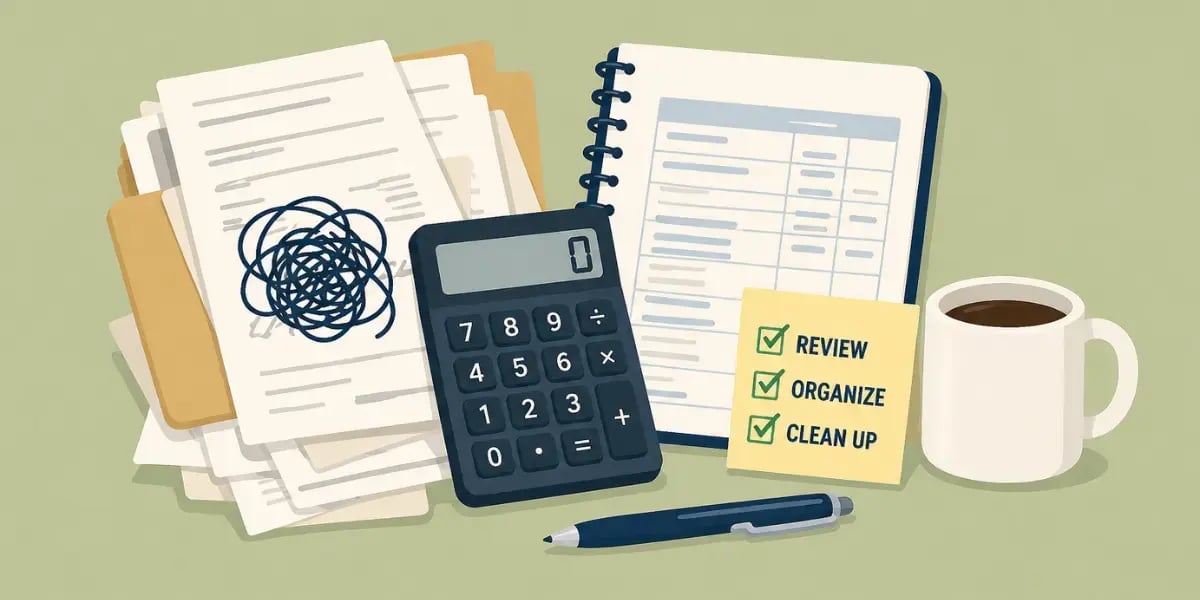
Maybe a lender asked for current financials, and you realized you can't produce them. Maybe an IRS or state notice showed up in the mail. Maybe your bookkeeper quit and left you with more loose ends than a ball of yarn. Or maybe you finally just want to know where your business actually stands.
Whatever brought you here, take a breath. This happens more often than most business owners admit. And yes, it's fixable.
The real question on your mind is probably this: How bad is this going to be in terms of time, cost, and stress?
Below, we’ll walk you through what "messy books" really means, how long cleanup usually takes, the factors that affect the timeline, and what you can do to speed things up so you know exactly what to expect.
What "Messy Books" Actually Means
Before we talk about fixing the problem, let's define it. "Messy books" isn't a single issue. It's a pattern of small issues that pile up over time.
Here are the most common signs:
- Uncategorized transactions. Months of activity sitting in a digital pile, waiting to be sorted.
- Reconciliation problems. Your bank and credit card accounts have never been reconciled, or the reconciliation broke somewhere along the way and never got fixed.
- Mixed personal and business expenses. The line between your wallet and your business account got blurry.
- A balance sheet that doesn't match reality. The numbers are there, but they don't reflect what's actually in your accounts.
- Books that don't match your last tax return. Your accountant filed based on one set of numbers, and your books tell a different story.
You don't need to know exactly which of these you have. If you recognize the pattern, that's enough.
Some businesses are only a few months behind. Others have years of cleanup to work through. Some have simple records. Others have layers of complexity from payroll, loans, or multiple accounts.
The key point: not all messes are created equal. Some take a few days to fix. Others take months. The right starting point is always the same. You need an honest look at where things stand today.
How Long Does It Take to Fix Messy Books?
Here's the honest answer: it depends.
Cleanup isn't always just data entry. It sometimes involves detective work. Every uncategorized transaction must be reviewed, matched to a receipt or a memory, and placed in the correct account. Reconciliations have to be rebuilt month by month, starting from the last point where things were accurate.
It takes time, but it’s manageable with the right process in place.
That said, here are typical ranges, depending on complexity:
- Small mess (1 to 3 months behind): a few days to a couple of weeks
- Moderate mess (6 to 12 months behind): a few weeks to a couple of months
- Major cleanup (multiple years behind): several months, sometimes longer
Timelines also shift when past income taxes need to be caught up at the same time. If you're behind on filing prior-year returns, that work has to happen alongside the bookkeeping cleanup.
The ranges above are starting points. Your actual timeline depends on a handful of specific factors, which we'll cover next.
5 Factors That Determine How Long Cleanup Takes
Some cleanups move quickly. Others take more time. The difference usually comes down to a few key factors that drive the timeline.
1. How Far Behind You Are
Time doesn't add up in a straight line. It compounds.
Three months of messy books is very different from three years. Each additional month adds complexity because earlier errors cascade forward. A miscategorized transaction in January affects February, which affects March, and so on. Fixing three months is a project. Fixing three years is a much bigger one.
2. Transaction Volume
More activity means more work to sort through.
A consultant with 25 transactions a month is faster to clean up than a restaurant with 500. Neither is better nor worse. They're just different situations.
Businesses with high transaction volume, like restaurants and retail, typically need more hours to clean up the same number of months.
3. Complexity of Your Business
The more moving parts, the longer the cleanup.
A single checking account and one credit card are simple. Multiple bank accounts, a few credit cards, payroll, inventory, loans, and multiple locations are not. Each account has to be reconciled. Each type of activity has its own rules. More complexity means more time.
4. Quality of Existing Records
The cleanup moves at the speed of the information available.
Clean bank and credit card statements speed everything up. Missing statements, lost receipts, or records spread across email inboxes slow things down.
If your QuickBooks is partially accurate, that gives the team a starting point. If it's completely off, the work basically starts from scratch.
5. Your Responsiveness as the Owner
This one gets overlooked, but it matters more than you'd think.
Cleanup work always raises questions that only the owner or controller can answer, like:
- What was this $3,400 transfer for?
- Was that charge at Office Depot personal or business?
- Is this vendor still active?
Cleanup moves at the speed of collaboration. When you respond quickly, things move faster. When questions sit unanswered, progress slows down.
How Much Does It Cost to Clean Up Messy Books?
Cost is one of the first questions most owners ask. The answer depends on the same factors that affect time:
- How far behind you are
- How many transactions need attention
- How complex your business is
A small cleanup that's only a few months behind costs much less than a multi-year project with thousands of transactions. Think of it like home repair. A leaky faucet is a quick fix. A full bathroom remodel is a different story.
What the Cleanup Process Actually Looks Like
Many owners are unsure what they are paying for during cleanup. Here is a simple breakdown of what the process usually involves.
|
Step |
What It Means |
|
1. Assessment |
Review the current state of the books and compare them to bank and credit card statements |
|
2. Chart of Accounts Review |
Clean up the list of accounts so the reports make sense |
|
3. Reconciliation |
Rebuild each account, month by month, starting from the last known clean point |
|
4. Categorization |
Place every transaction in the correct account |
|
5. Balance Sheet Cleanup |
Fix undeposited funds, old receivables, and any mystery balances |
|
6. Match to the Tax Return |
Tie the books to your most recent filed return so everything lines up |
|
7. Accurate Reporting |
Produce clear monthly financial reports you can actually use |
|
8. Ongoing System Setup |
Put a simple monthly process in place so the books stay clean from here forward |
The last step is often the most important. Fixing the mess matters. Keeping it fixed matters more.
How to Speed Up the Cleanup Process
You can play a big role in how quickly things get back on track.
Start here:
- Provide bank and credit card statements upfront. Every month, every account. The more organized your document handoff, the less back-and-forth later.
- Answer questions quickly. Set aside some time during cleanup to respond to your accountant's questions. That alone can shave valuable time off the project.
- Stop the bleeding. Put a system in place while the cleanup is happening, so new transactions are handled properly from day one. Otherwise, the team finishes cleaning up last year, while this year's piles up.
- Don't wait until a tax deadline. Cleanups done in a panic can take longer, cost more, and create more stress. Starting early always beats starting late.
None of these is difficult. They just require some intention.
You Don’t Have to Figure This Out Alone
If reading this made you realize your books need attention, you're in good company. Most small business owners hit this point at some stage. Messy books aren't a sign of failure. They're usually a sign you've been busy running your business.
At some point, though, the financial side needs structure and consistency.
This is where having the right help makes a difference.
At TMA Accounting, we help small business owners bring their bookkeeping, payroll, and income taxes under one roof. You get one team, one system, and one clear source of information. That means fewer surprises and less stress.
If your books are behind, the first step is simple.
Try our Price Estimator to see what ongoing support from TMA would look like for a business of your size. It takes just a couple of minutes, and there's no pressure to move forward until you're ready.
Messy books don't fix themselves. But with the right help, they also don't have to stay messy for long.

Blog Disclaimer: Nothing in this post constitutes legal, tax, or financial advice and is intended for informational and educational purposes only. This informational and educational material is not intended, and must not be taken, as legal, tax, or financial advice on any particular set of facts or circumstances or as recommendations that are suitable for any specific person. You need to contact a lawyer, accountant, or financial adviser licensed in your jurisdiction for advice on your specific questions, issues, and concerns. View our full Terms of Use here.
Topics: